
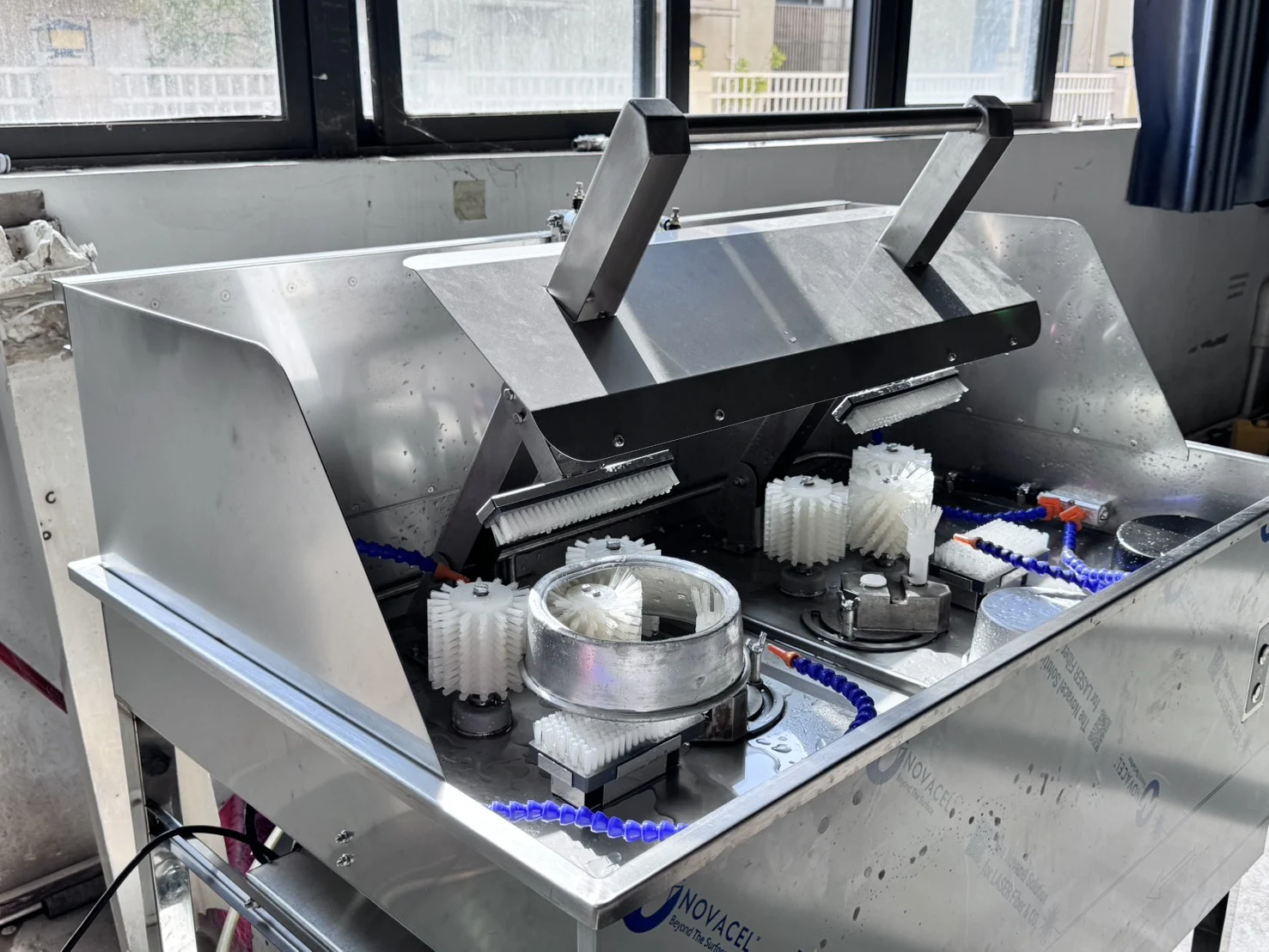
Specifications
| Quantity / window | Required accepted rate | Interpretation |
|---|---|---|
| 600 / 3 h | 200 / h | Below the stated range, but the complete workflow still needs testing. |
| 900 / 3 h | 300 / h | At the lower edge of the reference range; include normal interruptions. |
| 1200 / 3 h | 400 / h | At the upper edge, with no allowance for downtime. |
| 150 / 40 min | 225 / h | Illustrative trial calculation, not a measured product claim. |
1. Start with the cleaning deadline
Count the molds that must return to production and the actual cleaning window. A daily total hides the peak: molds arriving together after baking may have only a short time before reuse. Separate sizes and coatings so that setup changes remain visible.
Divide the required accepted quantity by available hours. The examples below are arithmetic planning scenarios, not measured machine performance. A requirement at the top of the reference range leaves little tolerance for interruptions.
2. Keep cycle time and throughput separate
The supplied product sheet states approximately 15 seconds for two molds and 300–400 molds/hour. Dividing 3,600 seconds by 15 and multiplying by two gives 480, but this omits loading, unloading, adjustment and inspection. Do not advertise that arithmetic ceiling as production capacity.
Count each mold once, after it passes the agreed inspection. A rejected mold that needs a second wash consumes time without adding another accepted item.
3. Run a representative acceptance trial
Record mold dimensions, residue, operators, settings and start/finish times. Include normal handling, size changes and rewash. Photograph the rim and base groove using a consistent method. A continuous run is more useful than a clip of the quickest cycle.
For example, 150 accepted molds in 40 elapsed minutes gives 150 ÷ 40 × 60 = 225 molds/hour. That is an invented measurement example to explain the calculation; it is not a V-TAI test result.
4. Use the result to plan the shift
Compare your target with the measured accepted rate, then reserve time for the facility’s separate sanitation, drying and storage process. Do not silently add those activities to a capacity figure measured only at the washer.
If the trial cannot meet the deadline, review batching, handling or the available cleaning window with V-TAI. A staffing reduction, water saving or financial payback needs its own baseline and measurements; hourly capacity alone cannot prove it.
A FEW USEFUL ANSWERS
Does a 15-second cycle mean 480 molds/hour?
No. That calculation excludes handling and inspection; the published reference is 300–400 molds/hour.
What should count as output?
Count accepted molds once after inspection and include rewash time in elapsed time.
The short answer
Write the target as accepted molds per hour, then verify it with your molds and a complete timed workflow.
Talk to an expertSources & product documentation
Based on V-TAI product information and the supplied product sheet. Final configuration and sample suitability should be confirmed with V-TAI.
V-TAI · VT-CE-CM2 ↗Download product sheet · PDF · Chinese · 2 pages ↗